what temp should filet mignon be cooked to
Information technology is undeniable that the almost tender, buttery, luscious steak on a cow is the filet. If you're jubilant, chances are skillful you're jubilant with filet! Only how should you prepare it? Here we take a look at a couple of options so you can figure out your favorite.
Filet Mignon: A Tender Favorite
It comes from the tenderloin—the least worked muscle of the animal, so information technology'southward the to the lowest degree tough. This ultra tender cutting of meat is likewise very lean. There isn't very much fat to add to its flavour and mouth-experience in the last product. Care has to exist taken to fix the meat to optimize the cut'southward texture.
What Makes a Great Filet Mignon?
The perfect filet mignon volition take a tender, juicy interior with a flavorful, crisp exterior. While complementary to the gustatory modality, these are actually two very different objectives and each will each take its ain careful preparation to reach.
A Tender, Juicy Interior
Nosotros'll starting time with the interior of the meat. Most connoisseurs of the omnipotent filet mignon would agree that it's sacrilege to let the meat melt beyond medium rare (130°F [54°C]). That'due south because, if information technology'due south cooked much further, this cut loses its buttery texture.
Filet Mignon Temperature Tip: Aim for an internal temperature of 130-135ºF, later on resting, for medium-rare.
Recall, there isn't much fat in the lean filet. Higher heat quickly denatures the poly peptide strands, making them tough and chewy. So we will have extra care in monitoring the internal temperature of our filet mignon! We'll also want to cook the interior of the meat slowly, to achieve uniformity of texture and gustation. Convection—the transfer of rut through the air—will be gentle plenty to bring the centre of the meat to the perfect doneness without overcooking the layers around information technology. "Low and slow" is the name of this game.
A Well-baked Exterior
For the exterior of the meat, however, we want the color and season of searing. Conduction—direct contact with a high estrus source—volition allow the processes of caramelization and the Maillard reaction to occur. Two stages of cooking for the perfect combination of flavors and textures.
Testing
To achieve this one-two-steak-punch, nosotros decided to try two methods:
one. Smoking the steak beginning (convection) and finishing with a pan sear (conduction)
2. Pan searing offset and then finishing in the oven
The initial "raw" preparation for both methods is exactly the same. Each is patted dry and then given a low-cal sprinkling of sea common salt.
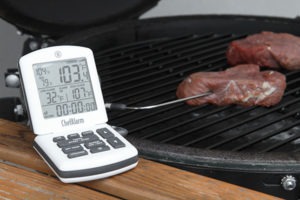
Filet Mignon Smoked then Pan-seared
Since nosotros are shooting for a specific internal temperature, the ThermoWorks® ChefAlarm® is the perfect tool. We set the alarm to sound when the internal temperature reaches 108°F (42°C)in the smoker and and so let it remainder to meet what the final temperature will be after carryover.
This method works great. We institute that the smoked meat increased a total 22 degrees up to 130°F (54°C) while resting—perfect medium rare doneness!
Subsequently the meat rests, we bring a sauce pan upwards to medium-high heat for nigh 3 minutes before introducing the steak. The steak is pan-seared over medium-high heat for about two-3 minutes on each side; long plenty for caramelization and the maillard reaction to occur—the processes that gives the meat flavour and browning.
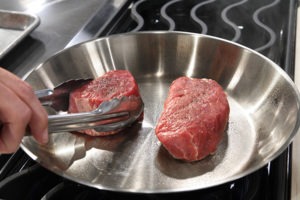
Filet Mignon Pan-seared and Finished in the Oven
For our 2d method, we showtime with the searing and then bring the interior up to temperature in the oven.
We follow the aforementioned method as before, searing the raw steaks for 2–3 minutes on each side in a pre-heated sauce pan. Then the steaks are transferred to a metal blistering sheet and placed on the middle rack of a 450°F (232°C)oven. Hither again, we utilize our ChefAlarm thermometer to track the internal temperature of the steak.
In our testing, after we pulled the steak out of the oven once, it reached 120°F (49°C). Carryover cooking increased its temperature to 135°F (57°C).
Interesting! The smoked steak's temperature went up by 7 degrees more than our pan-seared steak. The smoker's temperature was lower than the pan, and took longer to reach its lower temperature of 108°F (42°C) just the temperature rise during resting was greater.
You may note that these are dramatic carryover temperature rises. But fifty-fifty on a 2d test, we saw a full 13°F rise during resting with normal resting conditions (the steaks rested uncovered on a cutting board at room temperature). The traditional wisdom is that you should encounter a 7 or 8 degree ascension during resting, but our testing suggests otherwise with this cut of meat (come across annotation).
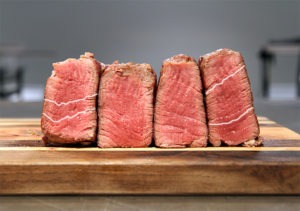
Our Results
See for yourself. On the left are the two steaks that were prepared with the pan-sear/oven method, and the correct are the two steaks prepared with the smoke/pan-sear method. The smoked steaks on the correct have clean, even edges and the muscle fibers are close together and fairly directly. The closer together the muscle fibers are, the more moisture the meat will retain.
The edges of the oven-cooked steaks on the left aren't as straight and clean, and the muscle fibers are more jagged than direct. They as well aren't equally shut together.
What happened is that the protein had a take chances to ready in the smoker before the steak was put in the pan to sear, then it wasn't initially shocked and shrunken from its raw state. The smoked steak had a noticeable only not-also-potent smokey flavor with a tender and smooth texture. The oven-finished steak was also very good, but the exterior texture was slightly tougher than the smoked one.
Typically, I swallow a well-prepared filet mignon with merely salt and pepper—why mess with perfection, right? But if y'all take a sauce that you love, especially one made from scratch, go for it!
The Takeaway
Both ii-phase methods work well. The texture of the interior of the meat was tender with both, but the steaks that were smoked first had meliorate flavor and were a scrap less tough on the exterior. The results represented the filet mignon in all its medium rare glory, cheers to precise temperature monitoring.
Happy Filet Mignon Weekend, carnivores!
**With such a dramatic temperature increase during rest, we had to test this again! We used the pan-seared and oven-finished method for our 2d test. We used the exact aforementioned procedures as we did the first time with the pan-searing. The steak was pulled from the oven at 120º F. The increase in temperature with the carryover cooking peaked at 133º F—another meaning jump. We still had the same consequence we were looking for, a tender juicy steak with a beautifully caramelized outer border.
More than on Cooking Steak and Temperature Tips
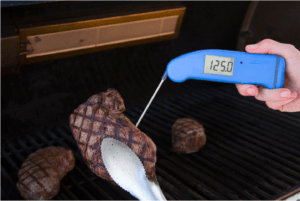 And the Science Behind It |  Medium Rare |
|---|

Source: https://blog.thermoworks.com/beef/filet-mignon/
0 Response to "what temp should filet mignon be cooked to"
Post a Comment